
The Tripwire Funnel is a highly effective sales strategy designed to convert cold leads into paying customers as quickly as possible. It works by offering an irresistible, low-cost product (the “tripwire”) immediately after a lead opts in, effectively breaking the “buyer’s block” and establishing a financial relationship.
What is a Tripwire Funnel?
A Tripwire Funnel is a multi-step sales process that prioritizes customer acquisition over immediate high profits. The goal is to turn a prospect into a customer by offering a high-value product at a significantly reduced price. Once a customer makes that first small purchase, they are statistically much more likely to purchase a higher-priced “core offer” or upsell later in the funnel.
How the Tripwire Funnel Works (Step-by-Step)
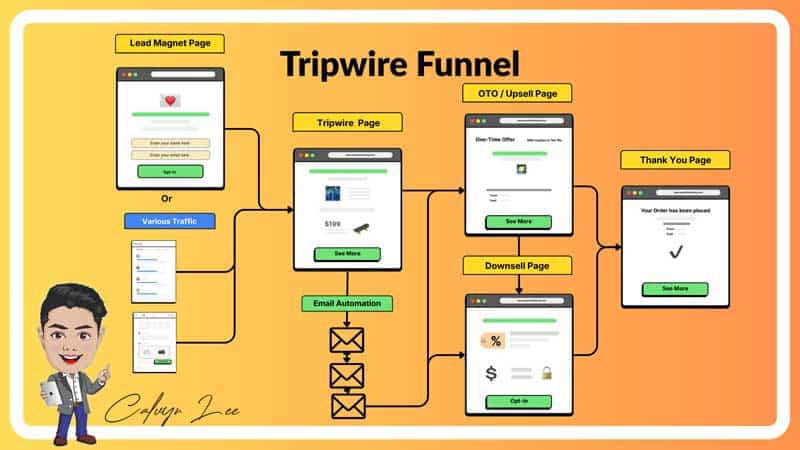
According to your diagram, the funnel follows this logical progression to maximize the value of every visitor:
1. The Entry Point: Lead Magnet or Direct Traffic
The process begins when Various Traffic (from sources like Google or social media) is directed to your offer.
- The Lead Magnet Page: Often, the funnel starts with a free offer where the visitor enters their name and email to “Opt-In”.
- The Transition: Once they submit their info, instead of just a standard thank you page, they are immediately redirected to the Tripwire offer.
2. The Tripwire Page (The “Irresistible” Offer)
This page presents the low-cost, high-value offer (the diagram illustrates this with an item, such as a skateboard, and a “See More” button).
- The Goal: To get the lead to make their first purchase. Even a small transaction changes the relationship from “subscriber” to “customer”.
- Automation: If they don’t buy immediately, the Email Automation sequence kicks in to follow up and encourage the purchase later.
3. The OTO / Upsell Page (Maximizing Order Value)
If the customer purchases the Tripwire, they are immediately shown a One-Time Offer (OTO) or Upsell Page.
- The Strategy: This is usually a more expensive, premium product that complements the Tripwire purchase.
- The Logic: Since the customer already has their credit card out and is in a “buying state,” this is the best time to offer a higher-value solution.
4. The Downsell Page (The Safety Net)
If the customer declines the Upsell (OTO), the funnel directs them to a Downsell Page.
- The Strategy: This page typically offers a smaller version of the upsell, a payment plan, or a significant discount (indicated by the “%” and “$” symbols in your diagram) to capture a sale that might otherwise be lost.
- Action: The user can “Opt-In” or click to accept this alternative offer.
5. The Thank You Page
The final destination for everyone who completes the purchase journey is the Thank You Page.
- Confirmation: This page confirms that “Your Order has been placed” and provides a summary of taxes and totals.
- Next Steps: A “See More” button is often included to lead them to the product they just purchased or to the next phase of your brand experience.
6. Email Automation (The Nurture Loop)
Connected throughout the entire funnel is Email Automation.
- Recovery: Emails are sent to those who opted in but didn’t buy the Tripwire.
- Retention: For those who did buy, these emails deliver the product and begin the long-term relationship-building process to eventually sell your core, high-ticket offers.
Tripwire Ideas for a Tripwire Funnel
Here are several high-converting suggestions tailored to your niche:
1. The “Done-For-You” Template Pack
- The Offer: A set of pre-designed funnel templates (ClickFunnels, GoHighLevel, or Canva) that match the diagrams in your course.
- Why it works: It removes the technical “how-to” barrier. Students have the theory from you; now they have the actual “plug-and-play” pages.
2. The Ultimate Swipe File
- The Offer: A collection of high-converting ad copy, email nurture sequences, and sales page headlines.
- Why it works: Writing copy is one of the hardest parts of building a funnel. Providing “fill-in-the-blank” scripts adds massive value for a low price.
3. A “Mini-Masterclass” on a Specific Technical Skill
- The Offer: A 60-minute deep dive video on a single topic, such as “How to Set Up Your First Meta Ad Campaign” or “The Tech Stack for Automated Webinars”.
- Why it works: It solves a specific, painful technical problem that might prevent them from finishing your main course.
4. The Funnel Audit Checklist & Calculator
- The Offer: A sophisticated spreadsheet that helps them calculate their ROI, CPA, and conversion rates, plus a 50-point checklist to audit their funnel before going live.
- Why it works: It positions you as an expert and gives them a professional tool they can use repeatedly.
How to Structure the Offer
Based on your Tripwire Funnel diagram, here is how to position these ideas:
| Component | Example Strategy |
| The Tripwire | $17 Funnel Template Pack. |
| The OTO (Upsell) | $97 “Copywriting for Funnels” Masterclass. |
| The Downsell | $47 Just the Email Sequence Templates (no video). |
Pro Tip: Make sure your tripwire is a “natural fragment” of your core offer. If your main course teaches the strategy of funnels, the tripwire should be the tools to build them.
Final thought, tripwire funnel also help you to filter out those non quality leads, only payable customer (a small commitment over tripwire offer) might possibility purchase your core offer. To know more about sales funnel, you may refer to earlier post type of sales funnels.